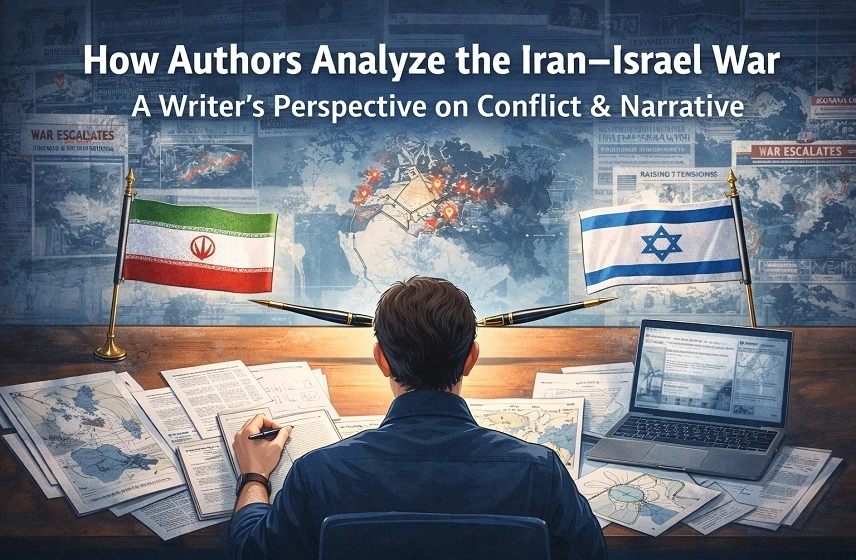
The bond between the US, Israel, and Iran has been a crucial point for a longer period of time.
These are constantly rising and range from economic supports to proxy wars to direct military actions, and have raised some serious questions.
Why did the United States strike Iran in the first place? Is it all about Iran’s nuclear program? Or are there extreme strategic goals that work here?
While the Geopolitical tensions among Iran, Israel, and the US worsened more than ever and turned into a regional war on 28th Feb 2026.
Now, the modern and smart authors and analysts are assessing the situation, they underline the change from a ‘’shadow war’’ to a direct, multi-theater. And possibly technically driven battles that comprise AI, with cyber warfare and regional trouble.
In the next section, we will explore insights and narratives introduced by smart writers to contextualize the war.
Why did the US attack Iran in 2026?
It’s been years, and the tension is growing between the USA, Israel, and Iran over Iran’s nuclear program and its ballistic missiles. And now its reach in the Middle East.
Despite the fact that an argument to confine Iran’s nuclear program began in 2025. After that USA removed itself from the agreement in 2025, led by the Press conference of Donald Trump.
He said it did not tackle sufficient of the outstanding problem, and then he made efforts to discuss a few agreements started last year and again in 2026.
However, those attempts failed, and that is why the US attacked Iran to gain nuclear Power.
Here are the key reasons why the USA struck Iran.
1. Geopolitical Interests in the Middle East
Iran owns a vital strategic position in the heart of the Middle East that, running alongside main US associates like the UAE, the KSA, and Israel.
Further, it impacts many other Islamic regions like Iraq, Syria, Lebanon, and Yemen. And thus places it as a regional power that directly challenges the USA to lead in the area.
2. Secure the Global Energy Routes
More than 20% of the globe’s oil passes over the Strait of Hormuz, which is a narrow but essential waterway hugely impacted by Iran.
So, if any danger to this passage can weaken world oil markets. Whereas the USA has a huge interest in making sure the constant flow of oil for both key reasons, like economic and strategic reasons.
3. Nuclear Program and Explosion Risks
Although Iran claims that its nuclear program is quiet and in good hands, the US and its associates stay cynical of its purposes.
So, stopping Iran from getting nuclear weapons is frequently cited as a justification for sanctions and military pressure.
As a result, it reflects both honest matter and strategic circulation.
4. Domestic and Global Political Pressures
Often, foreign policy is formed by internal political dynamics. So, the tensions with Iran normally has been tackled to attract attention from both domestic problems and political support for the duration of the election cycles.
It mostly happens when national unity is sought through external hostility.
5. Impact of Lobby Groups and regional Allies
Pro-Israel interests, who are aligned with mostly rich lobbying institutes, they use huge impact on US foreign policy.
As there is a solid political momentum inside Washington to take a tough attitude against Tehran, frequently encouraged by Israel itself, and Iran's open anger at the direction Israel is set.
Important Views from Modern Writers and Analysts:
1. Regime Vulnerability and Change:
According to Beni Sabti and other observers, the 2026 strikes have made the Iranian rule visible as a "right tiger," suggesting that the confluence of protests, global pressure, and domestic economic issues makes this an essential moment for a possible regime collapse.
2. The "Final Battle" Narrative:
Writers like Alireza Jafarzadeh portray a liberating time, underlining the Iranian people's wish to defeat the Islamic Republic and look ahead to a future free of the present government.
3. Strategic Realignment
As reported by the Independent, pundits like Bari Weiss suggest that the strikes are a weighty chance for a complete, long-term relocation of the Middle East.
4. Concerns of Escalation:
On the flip side, analysts from the Gulf International Forum agree that it is hard to keep the war under control. They stress that even while Iran might seem alone in this one, the conflict might lead to more widespread instability in the area.
5. The "Paper Tiger" View:
As per to various accounts from Facebook users, the 2026 struggle has revealed Iran's flaws, and experts assume the government is going through a supreme existential crisis.
6. Imperialism vs. Defence:
Reports from the Socialist Workers Party also present the fight as an imperialist war of aggression meant to overthrow the current government, rather than as a necessary defense.
Introduction to powerful authors and their input to the Discourse.
Prominent Writers and Their Works
-
Dr. Sanam Vakil- Dr. Sanam Vakil is the director of the Chatham House Middle East and North Africa Program. Dr. Sanam Vakil is a key figure in Iranian domestic politics and the survival of the regime. Her most recent research focuses on how the conflict has entered an "existential" stage for the Iranian state as a result of the strikes in February 2026, which allegedly targeted the supreme leadership.
-
Mohsen M. Milani: Mohsen M. Milani wrote in his most recent book, Iran's Rise and Rivalry with the US in the Middle East (2025/2026), that he offers a full account of the Axis of Resistance's strategic development. Further, he investigates how Iran continued to have an impact on the region in spite of decades of containment.
-
Paul Tiyambe Zeleza: Paul sees the US-Israeli attack as an extension of a long-standing colonial pattern of Western-aligned force projection and opportunistic intervention.
-
CSIS Analysis (Seth G. Jones, et al.): He examines the shift to "overt state-to-state warfare" and emphasises how "Operation Epic Fury" (February 2026) could be a trigger for regime change or complete collapse.
The Analysis at Chatham House in late Feb 2026, suggested within the context of early analysis about the potential US and Israel attack on Iran.
‘’Even if sections of its leadership and command structure are degraded, the Islamic Republic has experience renewing under pressure," it stated.’’
Diverse Perspective- Hawks vs. Doves: Analysis of differing viewpoints on military intervention about the US, Iran, and Israel war
Hawks and Doves are concerned about the US, Iran and Israel affairs deeply on the efficiency of military force against diplomacy.
While Hawks activists for direct military action, maximum sanctions, and changing the rules to neutralize fears.
On the flip side the main priority of doves in diplomatic negotiations is regional stability and fear that the rising tension can lead to devastating regional war.
Main Differences:
Monetary Policy (Finance)
-
Hawk- Well, the main and key focus of Hawks is to take control of the rising inflation by increasing the interest rates and decreasing the money supply. They favor a tighter monetary policy.
-
Dove-Their main goals are to rouse economic progress and employment with maintain the interest rates. Moreover, they favor and want a more expansionary loose monetary policy.
Foreign Policy/ Politics
-
Hawk- They mostly support aggressive, proactive, and usually prefer military solutions on the way to global problems.
-
Dove- In contrast to the hawk, doves generally favor diplomacy, negotiation, and calm solutions to fight.
Expert Writers Saw This Occasion Early. This is what sets them apart from everyone else
Remember, the most qualified individuals in the room are not always the writers who go on to write the seminal works about significant historical occurrences.
They are not always the most notable or well-connected. They are anything more candid and useful than any of that, which is what sets them apart. Also, they acknowledged that their unique angle, experience, professional expertise, or knowledge.
Moreover, millions of readers who were looking for precisely what they had to offer found the issue to be urgently relevant. So, when the window closed, they took action based on that realization.
Are you having trouble grasping what is going between the USA, Iran, and Israel?
Join a seasoned publisher in the UAE. They will surely help you out. They have a team of brilliant and certified tutors who can teach you in detail.
At the moment, people are currently searching for Iran-Israel war books, Middle East crisis analysis, US foreign policy defined, and Iran nuclear program books in large numbers, signifying how unsettling and dangerous this conflict feels to regular readers.
However, they are not finding enough. So, the grave, significant, deeply informed books that our period requires are not yet on the shelf because those who could write them are still considering whether to begin.
As a result, a gap represents an opportunity. A real one with a period limit bound to it.
Who Has the Book That Readers Are Actually Looking For?
If you want to gain more info and grasp the present tri-lateral tensions among Iran, Israel, and the US, being a reader, you must inclining on the way to a mix of fast historical accounts and as well strategic deep dives.
Since March 2026, here are the following authors and books have been considered the most crucial for grasping the key matters about the US, Iran, and Israel.
The Book Readers are actually searching for
The most demanding title in early 2026 is.
Israel, Ira and the USA: The 2025 conflict, written by Bryan Anthony.
This book is basically a work of fiction, mostly, and is based on predictive scenarios in early 2026.
Reason why this book is ideal for readers
Because the books it integrates quality military strategy by having vast relevant human stories of common individuals in the region Jerusalem, Tehran, and San Diego.
Moreover, the book is generally seen as the conclusive version of the 2025 clashes that changed the Middle East Geopolitics.
Do I need to become a professional Writer to publish about the Iran, US, and Israel conflict?
No, you do not need to become a specialist writer; you will need knowledge, a point of view, or a genuine and reliable story that the story people cannot find.
Even though credentials in journalism or academia can offer with traditional publishing. Any person who has access of internet can self-publish via the platforms mentioned below.
Publishing Paths
Well, based on your aims and background, you will need to select between two main paths.
-
Self-publishing-If you do not know or lack a specialist writing background, self-publishing is the most commonly used platform now for publishing. There are plenty of platforms such AS, KDP, or lulu enable you to upload your manuscript and will help you reach to the global audience.
-
Traditional Publishing- There is one more path that is traditional publishing; the problem is that this method is very competitive. Normally, publishers look for a proven platform for non-fiction writing, mostly about facts, and since you are writing about politics. People who choose this platform are mostly experts, academic and have a vast social media following.
-
Expert Policy Outlets-Think about ‘’think tank blogs,’’ or policy journals if your writing is more scholarly or analytical. Submissions from independent researchers and experts in the area of expertise who cannot always be full-time journalists are frequently accepted by publications like The Middle East Institute, Atlantic Council, or Small Wars Journal.
To become a full-time author or need guidance, reach out to the reputable Gulf Book Publishing house.
Building Reputation (The "Non-Writer" Advantage)
Since you are not a "professional writer," your approach is what gives you credibility. To be taken seriously on a topic with such high stakes.
As there are plenty of risks you can face, it can damage your reputation.
-
Cite Your Sources: First of all, you need to use a link with hyperlinked evidence. The caliber of your receipts is the foundation of your credibility in geopolitics.
-
Identify Your Lens: Are you writing as a data analyst, a concerned citizen, or a local family member? Honesty fosters trust.
-
Steer clear of jargon: Writing for people is one benefit of not being a professional. Punchy, clear prose frequently outstrips "academic speak."