Picture this: It’s 2:00 AM, and I am staring at my laptop screen. The fan whirs lazily against the humid night air, and I am three coffees deep into what I swear is going to be my breakout novel.
I have got a killer opening line which goes like, “The shadow whispered secrets only the dead cloud could hear,” and I’m typing furiously. By dawn, I’ve got 5,000 words written. Victory!
Fast forward to six months: the manuscript is a digital graveyard. Characters whose names I have forgotten, plot holes you could drive a rikshaw through, and a theme was vapourised like a monsoon mist.
I closed my laptop and swore never to write again. Sound familiar? Yeah, me too. It was my third novel in disguise.
But here’s the plot twist: I did not quit. I learned this the hard way: I started writing a novel without prep. It is like cooking machboos without rice.
So if you are itching to pen that epic tale but want to avoid my graveyard of half-baked ideas, stick around.
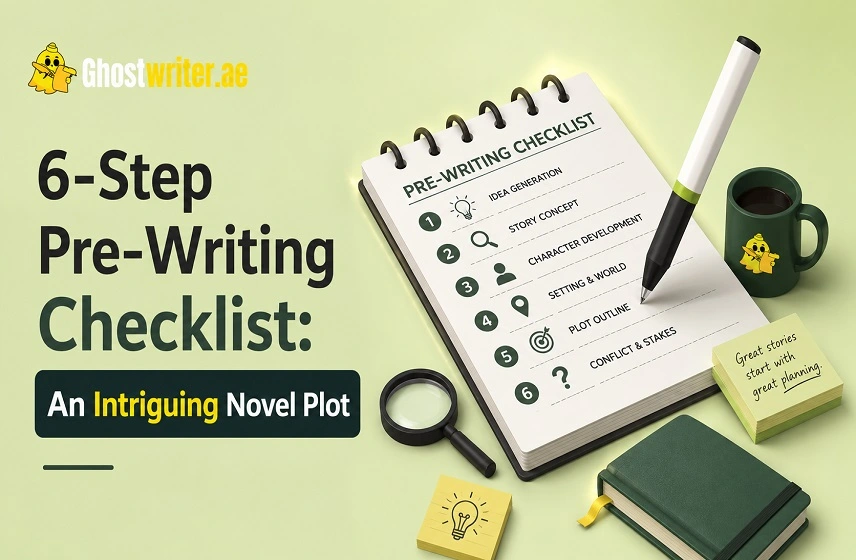
I am going to pour the tea on the final checklist in this blog to know that your narrative is ready to get in the water. No more abandoned drafts. So grab your notebook because we are about to story-proof like pros.
The Rookie Mistakes That Killed My First Three Books (And How You Avoid Them)

Let’s remind ourselves of that fateful night. I had passion, sure. A vague idea about a haunted place in the UAE, a protagonist with a mysterious scar, and villains who were…evil? I didn’t know, I just wrote.
Result? A mess. My hero went to and fro like a politician during the election. The storyline was zigzag without a definite direction. And the ending? It was not there as I had no plans.
| The brutal truth: 94-97% of aspiring authors quit before completing their books. |
It does not happen due to a lack of talent. Their narratives were not combat-fit.
I would have been glad if someone had given me this checklist several years ago. It would have saved me a few years of heartache and therapy bills.
So let us cover the big rocks: concept, characters, plot skeleton, world-building, themes, and that sneaky voice in your head saying “you’re not enough.”
1. Nail Your Core Concept (Is It Fresh or Just Familiar Fodder?)
Were you ever in a situation where you pitched your idea of the book to someone and they responded, Cool, like that movie? Cringe. When it comes to a clone, it will fail more than ever.
Test it: Boil your idea down to a killer sentence. Mine used to be: “Girls find a magic scar that reveals a ghost.” Yawn, now?
“In a crumbling haveli, a scar-faced historian uncovers her family’s pact with jinn–who demand her firstborn to break a 200-year curse.” Boom–hooks you, right?
Concept readiness checklist (score yourself 1-10 per item; aim for at least 40)
- Uniqueness factor: Is it a mash of two unlikely genres or tropes (e.g., cosy and mystery, fantasy and crime, or literary fiction and noir)?
- Stakes clarity: What happens in the worst case of the failure of the hero? World ends? Heart shatters? Make it personal and epic.
- Hook power: Are you able to pitch within 15 seconds and get me to tell you more about the part of the readers?
- Market fit: Who is your reader? Romance lovers? Thriller junkies? Competitive titles on Goodreads should be researched, and yours must be viewed as such.
- Sustainability: Would you be able to sustain 80,000 words on this? No thin ice.
Keep in mind that the story runs on your idea. When it is feeble, then the entire thing collapses.
2. Build Characters That Bleed Ink (No Cardboard Cutouts Allowed)
Remember my scar-faced historian? She started as a brave girl. Boring.
She is now Dr Ayesha: divorced, allergic to cats (important to this plot twist in the jinn), unsettled by the unresolved murder of her mother, and addicted to chai at night, reading ancient Urdu manuscripts.
Readers do not focus on plot; they are crazed about people. Your book is DOA unless you have flat characters.
Character Readiness Checklist
- Flaws that bite: What is their fatal flaw? Ayesha is in denial. She ignores jinn signs because her belief is that Science explains everything.
- Backstory goldmine: This is one crucial event in the past that frightens them most of all. Also, attach it to the plot.
- Desire vs. need<: They chase desire (fame, love) but need growth (courage, forgiveness).
- Voice uniqueness: The way they speak. Ayesha infuses Urdu poetry with arguments; her opponent, Jinn, speaks in riddles.
Story time: My second novel failed because the villain was an evil person. Lame. Provide villains with sympathies. The end of Stranger Things is a good illustration. Did we not get sad about how the Mind Flayer possessed Henry as a child?
Pro Tip: Interview your characters like a nosy auntie at events. Inquire what their greatest fear is. Secret shame? They will jump off the page should they be real to you.
3. Plot Skeleton–Your Story’s Invisible Backbone

Ah, plotting. The curse of pansters (those writers of the seat-of-the-pants). I was one - pure chaos.
Now, I outline like a detective.
It is not a straight line plot. It is a rollercoaster with highs (inciting incidents, midpoint twist, valleys and a scream-worthy climax).
Plot Readiness Checklist
- Inciting Incident: By page 10 of my book, the lift has flipped. Ayesha touches the scar and a jinn appears.
- Rising action beats: 5-7 escalating objects. Each raises the stakes.
- Midpoint game-changer:: False hero wins, and it is shown that it was a menace.
- Climax and resolution: Epic showdown with emotional payoff. No loose ends.
- Pacing pulse: Alternate action, dialogue, reflection. End chapters on hooks.
- Subplots weave: Romance, betrayal – all that nourishes the central one.
4. World-Building That Immerses (Without Info Dumps)
Fantasy? Sci-fi? Even realistic fiction needs a vivid sandbox. My haveli is not just an old place; it’s creaking teak doors etched with protective ayats, air thick with attar and dust, jinn lurking in flickering diyas.
Word Readiness Checklist
- Rules lockdown: Magic/jinn story? Consistent, limited. No deus ex machina.
- Sensory overload: Sights, smells, sounds. UAE streets: extremely hot and dry weather, smell of frankincense, call to prayer.
- Map it out: Sketch it out. Visualise the journey of the characters.
- Foreshadowing seeds: Drop hints early.
Warning with woe: I info-dumped my Haveli history in chapter one. Readers bailed. So handle it through action/dialogue. You are supposed to experience the world you are in, rather than preach it.
5. Theme, Tone, and that Nagging Inner Critic
Theme is your story’s soul. What is it really about? Mine: Family can be saved, but only confronted with buried truths. Tone: Mystery novel in an atmosphere of humour.
Final Polish Checklist (Self-assess honestly)
- Theme resonance: Reflection in each chapter. Subtle not preachy.
- Consistency of tone: Dark humour? Heart-pounding suspense? Match genre.
- Ending echo: Circles back to the hook/opening image.
- Word count reality: 80k-100k? Get rid of unnecessary words.
- Proofread: Read aloud. Does it flow? Gut-check fears.
The chai break moment: Take a one-week break from your manuscript. Return with a fresh perspective.
6. Polish to Power: Become an Expert Executor
Okay, so guys. Break over and eyes open. You took some time away from the manuscript. Now make use of that point of view. Drafts are often killed in the almost-ready zone. So, shift to execution mode.
Execution Checklist (Score 1-10; 40+ = Write Down)
- Synopsis page: One page max. Mine had Ayesha’s pact, jinn demand and curse break. Nailed it right?
- Chapter outline: 25 scenes, hook at the end of the chapter.
- Word sprint: Write for 25 minutes without editing. Repeat 4x daily.
- Seek professionals: Arrange a weekly meeting with professional novel writers UAE.
- Commitment to write: Promise yourself not to delete anything before 50k words.
Master Scorecard: Story-Proof Your Beast
Tally up. 220+? The engine roars. Revise lows.
| Section | Max | Yours |
|---|---|---|
| Concept | 50 | |
| Character | 50 | |
| Plot | 50 | |
| World | 40 | |
| Theme | 40 | |
| Total | 230 |
What If You Still Feel Stuck?
Let me share a secret that most experts do not tell. Sometimes you have the story, but you do not have the time.
The latest novel ghostwriting service has begun to collaborate, critique, and support each other. If you are a professional with a demanding career or if you realise through this checklist that your strength lies in ideation rather than execution, there is no shame in seeking help.
Remember that getting help from experts is not cheating. It is a partnership.
For example, think of it like hiring an architect for your dream home. You can have the kitchen the way you want it. You know what view you want out of the bedroom. The architect makes sure that the foundation is not weak and the roof is not leaky.
Likewise, a ghostwriter makes sure your plot framework works, your timing is correct, and your writing is impeccable. Hence, there are tons of benefits of hiring ghostwriters.
Do you know most of your favourite bestsellers were made by a team? When your checklist score is low, either in Plot or in the area of Execution. You might want to think that engaging in the support of a professional may be the key that opens your book.
Final Words
The challenge of writing a novel is one of the most rewarding. It involves susceptibility and practice. Yet, it does not need to be an isolated battle.
Use the checklists discussed in this guide. And be honest with your scores. You can begin writing tomorrow if you have passed all the checklists. But if you find gaps, then fill them asap. Also, you will require a friend to help actualise your vision. You can also attend a local writing group or seek the services of a professional, but the desired outcome is the same: to get your story out of your head and into the hands of readers.
Your story matters. Don't leave it as a cemetery on the Internet. And lend it the bones, the blood, and the breath it earns.
Go and write that first chapter now. I will be cheering you on, with less than three coffees this time, on my laptop.
FAQs
How do I know if my novel idea is unique enough to succeed?
You must first understand that true originality is rare for a unique and successful idea. Most successful books succeed by offering a fresh take on familiar themes rather than reinventing the wheel. Hence, you need to have a unique voice and perspective.
What is the first thing to prep before writing a novel?
The very first thing you need to prep is your premise. It is just one or two sentences of your story’s core conflict. You need to know who your character is, what they want, and what is standing in their way.
How do I create characters readers obsess over?
Character descriptions must be beyond flat descriptions while focusing on their internal landscape, humanising flaws, and active energy. Readers obsess when they do not just see a character, but become them through shared emotional experiences.
What is the ideal word count for a debut novel?
The ideal word count is between 80,000 and 100,000 words for most fiction novels.
Can ChatGPT write a novel for me?
No. You cannot simply tell ChatGPT to write a novel and produce texts that is long enough to qualify for a novel.